
AMD Advanced Micro Devices Inc
WKN: 863186 / ISIN: US0079031078AMD - langfristig ein Kauf ?? o. T.

Moves fast to pip Intel
By Charlie Demerjian: Montag 07 Mai 2007, 08:40
AMD IS DOING something that we haven't seen a chip company do in a long time, sandbagging its official roadmaps.
A while ago we told you about the intended launch frequencies, basically 1.9-2.5GHz, but that was before B0 parts came back.
We were told that the B0 stepping was due a few weeks ago, early April to be inexact, and they've been returned for inspection. If they were clean, they would be the launch stepping, and the Q2 date was do-able. If not, add in another few months, and you were looking at the end of Q3, maybe.
We understand that people in Austin were 'dancing in the aisles'. When asked if that was because of B0, we were told that people are very happy, very very happy, but he had 'never heard of such a thing'.
Another source claimed the memory controller, long a bottleneck in K8 scaling, came in way better than expected.
So what do you end up with? A massive gain in frequency. How massive? Almost 500MHz. Instead of the much touted launch parts, look for five SKUs at launch, AM2 quads at 2.6GHz, 2.7GHz and 2.9GHz, a dual at 2.7GHz and a quad on socket F at 2.8GHz.
We think whoever worked this magic deserves a pat on the head, a few days off after launch, and quite possibly a raise. Twnty per cent faster out of the gate is nothing to be sneezed at. The only question that remains is what volumes AMD can deliver at these speeds. µ
Quelle: golem.de
AMDs geschrumpfte Dual-Core-Turions lieferbar
Günstige Notebooks sollen in Kombination mit Onboard-Grafik länger durchhalten
AMD liefert seine mit zwei Kernen bestückte Notebook-Prozessoren der Serie "Turion 64 X2" nun auch mit auf 65 nm geschrumpften Strukturbreiten. In Verbindung mit dem bereits vorgestellten Notebook-Chipsatz M690G mit integriertem Radeon-X1200-Grafikprozessor und Display-Cache-Funktion soll die Akkulaufzeit im Vergleich zu den vorherigen AMD-Mobil-Plattformen merklich verbessert worden sein.
Der Hersteller verspricht, dass alleine der "Display Cache" bei gleichem Prozessor für eine bis zu 30 Minuten längere Akkulaufzeit sorgt. Das ganze Paket aus 65-nm-CPU und Chipsatz soll im Vergleich mit älteren AMD-Mobilplattformen laut Marketingversprechen bis zu eine Stunde länger durchhalten. Letztlich will AMD damit günstige Notebooks ermöglichen, die über 5 Stunden durchhalten können.
Vorgestellt wurden bisher folgende, jeweils mit 1 MByte Level-2-Cache bestückten 65-nm-Turion-64-X2-CPUs:
- TL-66: 2,3 GHz, 35W TDP
- TL-64: 2,2 GHz, 35W TDP
- TL-62: 2,1 GHz, 35W TDP
- TL-60: 2,0 GHz, 31W TDP
- TL-58: 1,9 GHz, 31W TDP
- TL-56: 1,8 GHz, 31W TDP
Ab sofort lieferbar sind laut AMD Deutschland die Modelle TL-56, TL-58, TL-60 und TL-62. Das Top-Modell TL-66 soll Ende Mai 2007 folgen. (ck)
... neuen Intel Centrino-Generation "Santa Rosa" sind wieder einmal "leicht positives" Marketing für AMD:
s. benachbarter Intel-Thread
und pcwelt.de
Confidence booster
By INQUIRER staff: Freitag 11 Mai 2007, 07:47
WE WONDERED why AMD share prices rose yesterday, despite many other shares dropping on the US markets.
But the reason could be because mutual fund giant Fidelity Investments announced in a filing that it's raised its stake in the somewhat troubled chip firm to 13 per cent, according to a report on Bloomberg.
Fidelity now owns 72.3 million shares of AMD. We believe that this time last year Fidelity owned a rather large 18 per cent of ATI, prior to its take over by AMD.
AMD closed on the NYSE yesterday evening at $14.05 - it had started off the day at $13.48. µ
_____________________
Was sollte eine Fondsgesellschaft mit 13 %? Sieht doch so aus, als wollte da jemand Mehrheiten bei AMD. Könnte es sein, dass Fidelity versucht, AMD zu zerschlagen, weil die Einzelteile (AMD und ATI) mehr wert sind, als das Ganze?
http://www.anandtech.com/cpuchipsets/showdoc.aspx?i=2986&p=1
http://www.gamestar.de/news/pc/hardware/amd/1465375/amd.html. Wieso geht es hoch? Gibt es andere Hintergründen oder ist nur normal Kurswellen
2) Die Gerüchte um Barcelona scheinen sich zu verdichten. Offenbar ist es AMD mit einem neuen Stepping gelungen, die Taktrate um bis zu 40 % anzuheben. Agena / Phenom CPUs werden wohl mit bis zu 3 Ghz erscheinen (vorher waren 2,5 Ghz im Gespräch).
Was bedeutet das? Nun ja.... AMD hat im Frühjahr die 2,5 Ghz Version mit Intel QX6800 gebenched. Ergebnis: AMD behauptete, schon der 2,5 Ghz Kern sei in vielen Bereichen bis zu 40 % schneller als der Quad Core von Intel. Angenommen, die neuen Gerüchte um höhere Taktraten bei AMD treffen zu. Dann befürchte ich, wird Intel so schnell nichts entgegen setzen können.
Auch Intels Penryn, der ja nur ein "Die Shrink" ist, wird das Ruder kaum "rumreißen" können. Die 45nm Struktur ermöglicht zwar höhere Taktraten bei gleichbleibender TDP. Aber selbst wenn Intel die Penryn Kerne auf 3,6 Ghz beschleunigen könnte (etwa 20 %), wird es kaum möglich sein, mit einem 3 Ghz Barcelona mitzuhalten.
Konsequenz:
Wenn AMDs Versprechen zutreffen, und sich die Gerüchte im Internet als wahr erweisen, ist es nicht völlig ausgeschlossen, dass AMD mit der "technischen" Wende auch den finanziellen Umschwung einleiten kann.
Denn: Sollten sich die neuen Prozessoren von AMD tatsächlich als leistungsfähiger erweisen, wird es für AMD möglich sein, deutlich höhere Preise durchzusetzen. Und AMD kommt derzeit ja von ganz unten. Dass Consumer Top Modell, der X2-6000 ist für läppische 200 EUR zu haben.
Zudem: Der Aktienkurs wird mit Erscheinen der neuen AMD Quad Cores zweifelsohne von Phantasien getrieben. "Der Underdog schlägt zurück" blah blah.........
Insgesamt eine interessante Investition, wenn man denn bereit ist, die Risiken zu tragen. Die Risiken sind jedenfalls nicht so hoch, als dass sich Fidelity hätte davon abhalten lassen, 13 % an AMD zu erwerben.
Was könnte Fidelity wohl im Schilde führen?
a) Möglicherweise sind die Einzelteile AMD / ATI mittlerweile mehr wert, als die Notierung der AMD Aktie an der Börse. Dies spräch auch für die Möglichkeit einer Zerschlagung.
b) Möglicherweise spekuliert Fidelity auch gerade darauf, dass Barcelona ein "Core 2 Duo-Killer" wird. Das Kurspotential zum letztjährigen Höchstand der Aktie ist jedenfalls erheblich.
c) Ergo: Ich glaube, man könnte eine kleine Position in AMD wagen.
Obwohl "el doktore" mit #157 und AnandTech (#155 - http://www.anandtech.com/cpuchipsets/showdoc.aspx?i=2986&p=1 ) recht logisch die Begründung dazu liefert.
PS: (unabhängig von diesem Thread) "el doktore" ist wohl eine Mischung aus dem spanischen "el doctor" und dem italienischen "il dottore"?
_AMD_3m_W-Form_.png (verkleinert auf 57%)

Naja, ich kauf mich auf alle Fälle wieder ein bisschen mit Calls auf AMD mit hoher (geduldiger) Laufzeit ein - z.B. den
- AMD Adv.M.|C|20|01.10|TUB DE000TB0NRX4
oder den
- AMD Adv.M.|C|20|12.10|SG DE000SG3G9D9
http://www.hkepc.com/bbs/itnews.php?tid=789466
Die würden die Preise nicht so senken, wenn sie nicht wüssten, dass Phenom die Leistungsspitze anführen wird.
1) Bis 1/2008 wird AMD hart am Limit kämpfen.
2) Ab 1/2008 werden die Verkäufe von Barcelona und Co die Bilanz aufbessern.
3) Inwiefern Barcelona Intels Core 2 Duo ins Abseits stellt, bleibt zwar noch abzuwarten. Spätestens auf der Computex im Juni sollte AMD aber mit ersten richtigen Benchmarks rausrücken.
New Chips, Cost Cuts Unlikely to Rally AMD Shares
By Nicole Ridgway |Nicole Ridgway Archive |Published: May 15, 2007
StockCompare
See how the stocks on this page stack up.
Price Check Calculator
What's this stock really worth? Try our new valuation
calculator.
Archive
Techsmart Archive
Watch the latest Techsmart video
Read/Post Comments | del.icio.us Reddit
Add this column to your News Alerts Digg it Newsvine
Print Send Sponsored by
AS FAR AS YEARS go, 2007 hasn't been a pretty one for Advanced Micro Devices (AMD: 15.33, -0.07, -0.5%).
AMD, which not long ago took the microprocessor world by storm, is now scrambling to play catch-up. It has lost significant ground to Intel (INTC: 22.04, +0.03, +0.1%), experienced major delays in launching new products and has seen its margins squeezed by falling prices. These issues (in addition to acquisition-related charges) caused AMD to swing to a loss of $611 million during its most recent first quarter. Finance chief Bob Rivet described it as "a terrible start to the year."
Of course, AMD says it has a plan to get out of its funk. That strategy entails cutting costs and growing the top line through more competitive pricing and the launch of new products. Certain pieces of that plan are starting to fall into place. On Monday, AMD launched part of its new ATI Radeon HD 2000 series of graphics processors and announced the naming of it new line of quad-core processors due out later this year. Last week, it said it would cut 430 jobs (2% to 3% of its work force), on top of previously announced plans to reduce its capex spending by roughly $500 million. The announcements have bumped the stock 15% higher since May 9.
I agree that these moves should help AMD regain its footing, but they may prove to be too little too late to completely turn 2007 around for the company. For investors, it's evident that a lot of the bad news has already been baked into AMD's stock price. The shares have fallen 51% in the past 12 months. Meanwhile Intel's shares have climbed more than 16%. However, I see few catalysts ahead to help sustain any meaningful gains in AMD's stock — at least over the next couple of quarters.
MORE ON STOCKS FROM SMARTMONEY.COM
Comcast's Service Problems Speak to Its Conflicts
Rig-Equipment Company Has Room to Rise
Prudent Bear's Tice Sees Credit-Tied Asset Inflation
Parsing the details of AMD's latest product announcements, for example, provides clues that the company continues to miss certain crucial marks. First, look at the new graphics processor line. This long-anticipated product launch is the first to come out of AMD's $5.4 billion acquisition of graphics chip maker ATI Technologies.
There's little doubt that there should be healthy demand from gaming fans and those upgrading their PCs to Microsoft's (MSFT: 30.97, +0.07, +0.2%) Vista operating system, but what's disconcerting to me is that it has taken so long to get the products out the door — and the line is still not completely ready for launch.
AMD initially anticipated rolling out the new graphics line last fall, around the same time that competitor Nvidia (NVDA: 34.12, -0.36, -1.0%) rolled out its GeForce series of GPUs. AMD's delays gave GeForce, which adds a second processor to the PC for running advanced applications like high-def video and PC gaming, a considerable seven-month lead.
Last month, AMD said its entire line of graphics processors would now be available in May. Sure enough, a launch was made in May. But if you look closely at the company's press release Monday, only the high-end Radeon HD 2900 XT is currently available. The other graphics card lines, the HD 2600 and HD 2400 series, aren't slated to ship until late June, leaving very little positive impact on the company's second quarter.
"In all of the excitement and the hoopla [surrounding the announcements], people may not have realized that AMD is once again experiencing execution issues," says Hans Mosesmann, an analyst at Nollenberger Capital Partners who's had a Sell rating on AMD's shares since December.
There's also been quite a bit of hoopla surrounding the impending launch of AMD's new quad-core processors. The quad-core puts four processors on a single piece of silicon and will be pitted squarely against Intel's Core 2 Duo and Core Extreme for desktops and its Xeon processors for servers. AMD spent a considerable amount of ink Monday on an announcement that merely said it had named the new desktop line of processors "Phenom" and a related platform "FASN8" (get it? — "fascinate"). FASN8 bundles two Phenom processors with high-end graphic chip, the HD 2900 XT.
I'll give AMD credit for choosing a cool name, but investors should keep in mind that the company's Phenom quad-core processors won't be available until the second half of this year. "You won't see Phenom in the desktop until probably Christmas," says Mosesmann. "Intel has a year lead."
AMD is banking on its claim that Phenom will offer faster speeds than the type of quad-core chip that Intel offers, which put two cores on two chips. Any financial benefits from the Phenom and Barcelona (the name of the quad-core processors for servers) however, probably won't be seen until 2008, says Mosesmann.
One near-term catalyst for the company's stock would be its second-quarter earnings report. During its quarterly conference call in April, the company said it expects revenue during the seasonally slow quarter to be "flat to slightly up." ThinkEquity analyst Eric Ross upped his rating on AMD Tuesday on the belief that demand from AMD customer Dell (DELL: 25.37, +0.70, +2.8%) will be stronger than anticipated during the quarter. Ross, who also raised his price target to $19 from $10, believes the company could beat expectations in the upcoming quarter.
AMD could surprise on the upside, but any gains probably won't be sustainable until all of the company's cost-cutting efforts are underway and its products launched. We can expect to hear more about the company's restructuring plans during a planned analyst meeting this summer. In the meantime, Nollenberger's Mosesmann believes the company's shares will remain in the midteens "up or down two points" throughout the summer.
Shawn Chen; Joseph Tsai, DIGITIMES [Wednesday 16 May 2007]
With AMD scheduled to showcase its new quad-core Opteron processors (Barcelona) at Computex Taipei 2007, Intel also plans to demonstrate its 45nm native quad-core server processors (Harpertown) at the show, according to sources at server makers.
Intel will only demonstrate Harpertown-based products in its own booth, and the 45nm native dual-core processor, Wolfdale-DP, will be absent from the show, added the sources.
In an update to previous reports, Barcelona-based products will be displayed in both AMD's and its server partners' booths. However, only AMD’s booth will have performance testing, with other companies only showcasing their own products.
AMD will release its Barcelona processors with clock speeds ranging from 1.9-2.6GHz. However, in the initial launch, the clock speed will top out at 2.3GHz, while the 2.6GHz version will appear in the updated version, pointed out the sources.
http://www.digitimes.com/news/a20070516PD210.html
__________________________________________________
Diese Angaben von www.digitimes.com, deren Informationen sich in der Vergangenheit immer als zuverlässig erwiesen haben, widersprechen dem Gerücht, dass einige Seiten im Internet verbreitet haben (ua. the-inquirer), wonach es AMD gelungen sein soll, die Clock rate um 50 % zu erhöhen.
Es sieht vielmehr so aus, als würden die Barcelona Versionen mit relativ niedrigen Taktraten erscheinen .
Dann stellt sich aber die Frage, ob der Performance Vorteil gegenüber Intel tatsächlich so groß sein wird wie angekündigt.
Bei der Präsentation im März wurde eine 2,5 Ghz Version des Barcelona mit einem QX6800 von Intel gebenched. Diese soll um bis zu 40 % schneller gewesen sein.
Nun sollen aber zunächst nur 2,3 Ghz Versionen erscheinen. Diesen 2,3 Ghz Versionen wird Intel ab 4/2007 seine 3,33 Ghz Penryns entgegensetzen. So, wie die Dinge liegen, wird der Wettkampf doch etwas ausgeglichener Sein, als zunächst befürchtet (s.o. posting).
Man darf also gespannt abwarten. Katastrophal wird es für Intel jedenfalls nicht, wenn sich die Angaben von Digitimes bestätigen.Im Gegenteil: Intel holt bereits zum Gegenschlag aus (45 nm).
AMD Barcelona launch schedule up in the air
§
Shawn Chen, Taipei; Esther Lam, DIGITIMES [Wednesday 16 May 2007]
AMD's original plans to introduce Quad-Core Opteron (Barcelona) CPUs are unlikely to be on schedule with a concrete launch-time still unknown, according to sources at Taiwan server makers.
The sources noted that AMD has informed them that the introduction of Barcelona will be delayed until August or September, instead of the originally planned June. However, the sources also noted that this schedule is still subject to change. The Barcelona CPU samples they have currently are not the final versions and bugs are still being discovered, they added.
AMD's only comment on the launch schedule was to say that it will be in line with its previous officially announced schedule, while in a recently published interview with Digitimes, Patrick Patla, director, server/workstation division of AMD, stated that the Barcelona launch will come during the middle of this year.
Still, some Taiwan-based server vendors commented that their confidence over AMD will be affected by any delay. Roadmaps for new product launches were mapped out by the vendors in 2006, and the delay of Barcelona will interrupt these schedule. Comments gathered from vendors show that the majority believe a critical impact will be seen amid Barcelona's delay.
Besides that the postponement may discourage confidence among server makers, AMD also has to face the potential threat from rival Intel whose 45nm-made Harpertown and Wolfdale-DP CPUs are still on schedule to be both launched as planned, according to sources.
By Michael Kanellos
http://marketwatch-cnet.com.com, marketwatch-cnet.com.com/AMDs+new+Puma+stalking+Intels+Centrino/2100-1006_3-6184712.html
Story last modified Thu May 17 21:00:03 PDT 2007
Advanced Micro Devices is coming out with its own Centrino.
The Sunnyvale, Calif.-based chipmaker is prepping an energy-efficient notebook chip, code-named Griffin, as well as a platform based around Griffin called Puma, (similar to Intel's Centrino) that will likely allow AMD to better compete in the rapidly growing notebook market.
Griffin will go into mass production toward the end of the year and Puma-based notebooks sporting the chips will hit in mid-2008, according to AMD Fellow Maurice Steinman.
Intel has produced chips sporting architectures optimized for notebooks since 2003 and has come out with new versions at a somewhat regular pace. Partly as a result, Intel has maintained a larger market share in laptops over AMD than in other markets.
After Griffin's release, AMD will follow with Fusion, a chip that integrates graphics into the processor core in 2009, he said. Fusion will first appear in notebooks. (Last year, AMD said Fusion would come out in 2008 or 2009.)
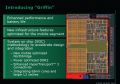
Griffin is AMD's first chip specifically designed for notebooks, said Steinman. AMD sells chips tweaked for notebooks now, but these products are effectively just more power-efficient versions of the other chips AMD sells into other markets.
"If you look at our current offerings, it's really the same basic microarchitecture being offered in notebooks, servers and desktops," he said.
By adopting a new architecture, the company says it can cut power consumption further without worrying as much about making changes that might affect how the architecture works in the server world, for instance.
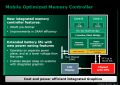
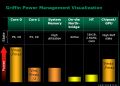
In Griffin, for instance, the two processing cores and the integrated memory controller-- which shuttles data back and forth between the processing cores and memory--are all on separate power planes. By separating all of these subcomponents in Griffin onto different planes, two can go into deep sleep states while the last one continues to work. The memory controller can also operate at a lower voltage.
In Barcelona, an upcoming four-core server chip from AMD, the memory controller is on a separate power plane, but the four cores are all on the same voltage plane, he said. Power consumption is important in servers, but not to the same degree as with notebooks, noted Steinman.
Griffin will also be able to drop to slower speeds when full performance isn't needed. Currently, AMD chips can drop to 800 megahertz. The cores in Griffin, independent of each other, will be able to drop to one-eighth the chip's stated speed. Thus, if it's a 2.4GHz chip, a single core will be able to drop to 300MHz to conserve power.
"You can get some real work done at those lower frequencies," he said.
In another twist, Griffin will be able to shut down lanes inside of the HyperTransport 3 links connecting different processors, when not in use, he said. These power savings techniques will largely be controlled by the CPU and the chipset, he said, and will be independent and above any power management techniques implemented by the operating system.
Griffin, though, won't be able to accommodate as much memory as a server chip, Steinman said. He didn't specify how much less, but said the chip was designed for notebook-size memory loads, not the massive amounts of memory servers can require. Again, this architectural difference saves power.
Throwing cold water on energy hogs Microsoft's Mundie looks beyond Gates Will labels sing along with DRM-free music? Extra: Russia accused of starting cyberwar against Estonia Video: Band jams on hacked 'Guitar Hero' controllers
The chip will initially come out on the 65-nanometer process. Each core will contain a 1MB cache.
Puma, meanwhile, will continue the power management theme by coming with a feature, called PowerXpress that shuts off the discreet graphics processor in notebooks when they are running on batteries. In the unplugged mode, notebooks will run on the graphics capabilities in the chipset.
Most notebooks, Steinman conceded, actually don't come with a discreet graphics chip, but it will save power for those that do.
Puma, though, may raise some diplomatic problems for AMD. For years, the company has carped about Centrino, claming that it locked notebook makers and consumers into an all-Intel world. In the meantime, AMD bought chipset and graphics maker ATI Technologies. As Centrino is all-Intel, Puma is an all-AMD solution.
AMD signaled it would start to move toward platforms last year.
In 2003, Intel came out with Centrino, a notebook platform designed around the then new Pentium M. The Pentium M relied on a different architecture than other Intel chips at the time and consumed substantially less power. Centrino also came with Wi-Fi chips, rare then, and the notebooks were tuned to ensure they would work with public hot spots. Sales zoomed and the success helped spur Wi-Fi adoption.
Copyright ©1995-2007 CNET Networks, Inc. All rights reserved.
AMD will Centrino mit "Griffin" und "Puma" kontern
Neue Notebook-Chips kommen erst 2008 und ohne K10-Architektur
<!--content-->AMD hatte seine Pressekonferenz unmittelbar am Morgen nach Intels Vorstellung der ersten neuen Centrino-Notebooks angesetzt und damit eine weitere Runde im unmittelbaren Schlagabtausch mit Intel eingeläutet. Senior Fellow Maurice Steinmann erläuterte in München, woran die Chipentwickler gerade arbeiten - erst Mitte 2008 sollen "Puma" und "Griffin" auf den Markt kommen.
|
|
|
WDH: AMD will in diesem Jahr Ausgaben um 500 Millionen Dollar senken
22.05.07 12:19
FRANKFURT (dpa-AFX) - Der amerikanische Chiphersteller Advanced Micro Devices (AMD) will in diesem Jahr seine Ausgaben um 500 Millionen Dollar reduzieren. Unter anderem werde die Produktion in der neuen erweiterten Chipfabrik in Dresden nicht ganz so schnell hochgefahren wie ursprünglich geplant, sagte Jochen Polster, Geschäftsführer von AMD in Deutschland, der 'Frankfurter Allgemeinen Zeitung' (FAZ/Dienstagausgabe). Konkrete Zahlenangaben zu den Einsparungen machte er dabei nicht.
Wachstumsmärkte für AMD seien China, Brasilien, der Nahe Osten und Afrika und in Europa Märkte wie Polen und die Türkei, sagte Polster./ne/zb
Quelle: News (c) dpa-AFX Wirtschaftsnachrichten GmbH.
K10, Barcelona to start shipping in Q3 Print E-mail
Written by Fuad Abazovic
Tuesday, 22 May 2007
Sources close to the company confirmed that the next generation Opteron, also known as Barcelona, won't start shipping in late Q2 as some expected.
Q3 sounds more realistic as AMD is still working to ramp out the production and the silicon is already out for a while. Q3 will definitely mean the start of recovery for AMD and by late Q3 the company should be getting back in shape.
http://www.fudzilla.com/...ion=com_content&task=view&id=1108&Itemid=1
Drum ist wahrscheinlich heute der AMD-Kurs wieder leicht nach unten gegangen (bzw. overseas geht er noch ...).
opportunity to buy now? ("Einkaufsgelegenheit"?)
Written by Lars-Göran Nilsson
Friday, 25 May 2007
Massproduction in late Q3 or early Q4
AMD has let slip that it will start sampling the Agena and Kuma core CPU's in July. First up are the 2.6 and 2.8GHz version of the Agena FX, which should also be the ones to arrive in retail first.
The Agena FX will be available in both for socket AM2+ and 1207+, although you'll have to make do with the 2.6GHz version if you don't want to use socket 1207+. This CPU will also be limited to single processor systems, as the AM2+ socket doesn't support multi CPU configurations.
The standard Agena range will initially be available at 2.4 and 2.2GHz, while the entry level Kuma processor will clocked at 2.5GHz.
We've provided some proof of the pudding below, but do note that these schedules are for sampling, not mass production. Expect to wait at least a couple of months before you can purchase one of these processors and the Agena FX will be the first chips on sale.
http://www.fudzilla.com/...ion=com_content&task=view&id=1172&Itemid=1
Siehe dort auch die verlinkte Grafik.
_________________________________________________
Ob diese Angaben verlässlich sind, kann man bei einer Seite wie Fudzilla nicht wissen.
Gehen wir einfach mal davon aus, dass diese Angaben zutreffen:
Agena ist der Code Name für die Desktop Version des Barcelona Kerns.
AMD wird also die FX Serie um einen Barcelona Kern erweitern, der mit bis zu 2,8 Ghz getaktet ist und aus vier Kernen besteht.
Zum Vergleich: Der derzeit schnellste Intel Quad Core für Desktop ist mit 2,66 Ghz getaktet. Ab Juli 2007 wird der QX6700 durch einen QX6800 abgelöst, der mit 2,93 GHz getaktet sein wird (http://www.dailytech.com/article.aspx?newsid=7293). Intel will stolze 999 USD dafür verlangen.
Bis der QX6800 mit dem Agena FX Kern in (Verkaufs-)Konkurrenz tritt, wird es noch einige Zeit dauern, wahrscheinlich bis August 2007.
Eines verstehe ich aber nicht: Wenn der neue Barcelona Kern tatsächlich um ein vielfaches effektiver ist, wie AMD behauptet, warum wird der Agena FX dann bereits bei Erscheinen mit 2,8 Ghz getaktet. Geht man nämlich mit AMD davon aus, dass der mit 2,5 Ghz getaktete Barcelona Kern etwa 50 % schneller ist, als ein vergleichbarer QX6600 (Vergleich aus März, siehe http://www.computerbase.de/news/hardware/ prozessoren/amd/2007/april/amd_barcelona_intel/), dann wäre ein mit 2,8 Ghz getakteter FX Kern doch der "absolute Overkill". Betriebswirtschaftlich zugleich völliger Blödsinn. Es macht ja keinen Sinn, eine CPU auf den Markt zu werfen, die die Produkte des Gegners um 100 % übertrifft. Schließlich kann AMD niemals mehr als 1000 USD für sein Topmodell verlangen. Es wäre daher doch völlig ausreichend, den FX dann erstmal mit 2,5 - 2,6 Ghz zu takten, um später mit derselben Architektur "Luft nach oben" zu haben.
Fazit:
Außer einer tollen Powerpoint Präsentation habe ich von AMDs neuen Produkten bisher nichts gesehen. Die Angaben von AMD sind zudem absolut unseriös: "Barcelona Quad-Core bis zu 50 % schneller". Mag ja sein: Aber die Frage ist doch schon: Bei welcher Taktrate (dies hat AMD bisher offen gelassen; die Presse hat 2,5 Ghz geschätzt); bei welcher TDP.
Wenn der Agena Kern wirklich die von AMD angegebene Effizienz und Geschwindigkeit hat, warum dann ein FX Kern mit 2,8 Ghz?
Und weiter: Wann kommt denn das "phenomenale" (Marktschreierei) Produkt? AMD mag Intel ja im Marketing und Sprücheklopfen überlegen sein. Aber meine Anlageentscheidung würde ich darauf nicht stützen. Mich würde vielmehr beunruhigen, dass AMD unlängst angekündigt hat, aus Gründen der "Effizienssteigerung" Mitarbeiter zu entlassen und die Erweiterung wichtiger Fabriken in Dresden und anderswo herauszögert. M.a.W.: Man spart bereits erheblich im Bereich "Produktion".
Und wenn das neue Produkt dann tatächlich auf dem Markt ist: Wird es den Erwartungen entsprechen? Wird AMD den finanziellen Umschwung schaffen? Immerhin plant Intel, seine Quad Core Preise bereits im Juli um bis zu 40 % zu senken. Damit wird im Mainstream Bereich der Konkurenzkampf weitergehen, so dass die Margen - für Beide - entsprechend gering sein werden.
Schließlich noch eines: Ab Oktober wird wohl mit den ersten Penryn Kernen zu rechnen sein. Diese werden die Produktionskosten von Intel weiter drücken, und Intel Spielräume für den Preiskampf mit AMD schaffen.
Bleibt zu fragenN. Womit wird AMD 2008 aufwarten, wenn Intel:
Nehalem to smash K10 marchitecture
Written by Fuad Abazovic
Friday, 25 May 2007
Second half of 2008
Intel refreshes its marchitecture every year or so and every two years they have a major marchitectural breakthrough. Core 2 Duo went out last year and swept AMD off its feet and next year Intel plans to refresh its offer with 45 nanometre Core 2 Duo / Quad CPU's codenamed Penryn.
The second half of 2008 is the interesting one, as Intel plans to have Nehalem chips with an integrated memory controller and some other interesting features. This chip will swipe K10 of its feet even at 45 nanometre and high clocks.
This is what our high ranking sources that are using both chips believe. It looks like from now on, one year will be AMD's, when AMD will be able to claim victory, while the next one will be Intel's.
We are getting odd victory cycles it seems.
http://www.fudzilla.com/...ion=com_content&task=view&id=1165&Itemid=1
Toshiba setzt bei Notebooks künftig wieder auf AMD-Prozessoren
29.05.07 18:37
(aktiencheck.de AG) - Die Toshiba Corp. (ISIN JP3592200004/ WKN 853676), der zweitgrößte Elektronikkonzern und Chip-Hersteller in Japan hat dieser Tage mitgeteilt, dass man künftig wieder 20 Prozent seiner Notebooks in den USA und Europa mit AMD-Prozessoren ausstatten wolle.
Dies ist ein kleiner aber auch herber Schlag für Intel. Denn bisher gab Toshiba dem AMD-Mitbewerber sein Vertrauen. Neue AMD-basierte Geräte werden Toshiba zufolge bereits für diesen Sommer erwartet. Die Prozessoren sollen in erster Linie im Mittelpreis-Segment zum Einsatz kommen und sind nicht nur für den Privatanwender-, sondern auch für den Businesskundenmarkt vorgesehen.
Quelle: News (c) finanzen.net.
AMD ATI Radeon HD2400Pro und HD2600XT
Die Mittelklasse der ersten Direct-X10-Architektur von ATI muss es richten: Mit dem Spitzenmodell ATI Radeon HD2900XT hat sich AMD nicht gerade mit Ruhm bekleckert. Doch richtig Geld verdienen die Hersteller in der Mittelklasse (Kartenpreis bis 250 Euro). Besonders interessant für Spieler dürfte dabei der Grafikchip Radeon HD2600XT sein. Dessen Chiptakt beträgt heftige 800 MHz und die Karten dürfen 256 MB GDDR4-Speicher mit einer effektiven Taktrate von 1,1 GHz nutzen. Verdächtig ist allerdings, dass Asus sowohl die Anzahl der Unified Shader Einheiten als auch die Speicherbusbreite verschweigt.
Nummer Zwei im Bunde ist der ATI-Grafikchip Radeon HD2400XT. Laut Asus arbeitet der Chip mit 525 MHz, den Speicher steuert die Karte mit effektiv 800 MHz an. Allerdings kommt nur DDR2-Speicher zum Einsatz, daher vermuten wir, dass der 2400XT-Chip nur bedingt spieletauglich ist.
Quelle: http://www.pcwelt.de/index.cfm?pid=1520&pk=82631&p=3
Quelle: http://www.golem.de/0706/52675.html
AMD halbiert Preise für Ein-Sockel-Opterons
Sämtliche Modelle der Serien 100 und 1000 deutlich billiger
Zum Startschuss der Computex 2007 hat AMD die Preise der Opterons deutlich gesenkt, die für Rechner mit einem Prozessorsockel gedacht sind. Die CPUs sind nun nur noch wenig teurer als ihre Desktop-Pendants.
So wurde das Top-Modell Opteron 1222 SE mit 3 GHz mit früher 655,- und nun 360,- US-Dollar ganze 45 Prozent billiger, die beiden kleineren Modelle mit 2,8 GHz, die sich nur in der Leistungsaufnahme von 103 Watt (1220) oder 125 Watt (1220 SE) unterscheiden, sind mit jetzt 265,- US-Dollar sogar für weniger als die Hälfte des früheren Preises von 545,- US-Dollar zu haben.
Die Preissenkungen betreffen die gesamte Produktpalette von der 100er-Serie bis zur 1000er-Serie für DDR2-Speicher. Da die 100er-Opterons in den Socket 939 für Mainboards mit DDR-Speicher passen, ergibt sich hier eine Chance zum Aufrüsten auch für Desktop-Boards, sofern das BIOS nicht nur Athlons, sondern auch Opterons ansprechen kann. Der Opteron 154 mit 2,8 GHz ist nun laut AMD für 189,- US-Dollar zu haben. Die Preise im deutschen Einzelhandel passen sich erfahrungsgemäß in einigen Wochen an. (nie)
AMDs Athlon X2 mit 45 Watt, neues Namensschema für alle CPUs
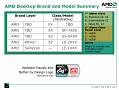
Auf der soeben im taiwanischen Taipeh gestarteten Computex hat AMD zwei neue Prozessoren der X2-Familie vorgestellt. Die neuen CPUs weisen nicht nur eine um 20 Watt niedrigere Leistungsaufnahme als ihre Vorgänger auf, sondern sind die ersten AMD-Prozessoren, die neue Modellnummern tragen. Dabei kommt das "Quantispeed-Rating" nicht mehr vor.
Die Neuheiten der beiden Prozessoren "Athlon X2 BE-2350" (2,1 GHz) und "Athlon X2 BE-2300" (1,9 GHz) sind schnell aufgezählt: Es sind Versionen des Brisbane-Kerns mit 512 KByte L2-Cache für jeden der beiden Cores, die durch verbesserte Fertigung mit 65 Nanometern Strukturbreite 20 Watt weniger Leistung (TDP) als bisher aufnehmen. Die beiden CPUs ersetzen damit die Modelle Athlon64 X2 4000+ und 3600+, die AMD bisher mit dem Namenszusatz "Energy Efficient" (EE) beschrieben hatte. Die neuen CPUs sollen für PC-Hersteller und Wiederverkäufer in 1.000er-Stückzahlen 91 bzw. 86 US-Dollar kosten und ab sofort nur für den Sockel AM2 verfügbar sein.
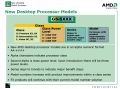
Mehr Erklärung bedarf AMDs neues Namensschema, mit dem sich der Chiphersteller von dem früher "Quantispeed-Rating" und später schlicht "Model Number" genannten Bezeichnungen verabschiedet. Sie waren 2001 für den Athlon XP aus der Not geboren worden, weil Intel mit immer höheren Taktfrequenzen werbewirksam davoneilte, AMD aber dank mehr Effizienz pro Takt vergleichbar schnelle Produkte im Angebot hatte. Das neue Schema wird zunächst nur für die beiden neuen X2-CPUs eingesetzt, soll beim Erscheinen der Stars-Familie der AMD-Prozessoren mit K10-Architektur aber weiter gepflegt werden. AMD will die bestehenden Produkte nicht umbenennen, aber beim Erscheinen von Nachfolge-Modellen mit gleichem Kern - wie den jetzt vorgestellten 45-Watt-CPUs - bereits verwenden.
|
|
Auch, wie die neuen Phenom-Prozessoren, welche die FX-Familie ablösen sollen, im neuen Schema benannt werden, hat AMD noch nicht bekannt gegeben. Lediglich, dass die Zwei- und Vier-Kern-Versionen der K10-Architektur (Stars-Familie) als Serien "6" und "7" bezeichnet werden, ist bereits offiziell bekannt. Fest steht aber, dass AMD die "64" aus neuen Produktbezeichnungen streicht. Wie das Unternehmen erklärte, sind 64-Bit-Prozessoren inzwischen Standard-Ware, es sei außerdem bekannt, dass AMD hier die Technologieführerschaft innehabe.<!--/content--> (nie)
Quelle: http://www.golem.de/0706/52662.html - s.a. http://scr3.golem.de/?d=0706/AMD-Namensschema&a=52662&s=1
AMD-Namen01.png (verkleinert auf 33%)